
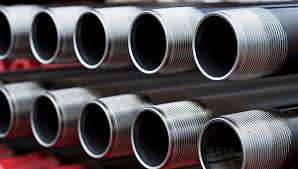
Oil Country Tubular Goods)
API 5CT, API 5DP & API 7-1 Tubular Products for Drilling, Completion & Production
Oil Country Tubular Goods are the precision-engineered steel pipes that form the structural and flow-conducting backbone of every oil and gas well. They are not commodity pipes; they are manufactured to exacting standards under API Monogram licenses, designed to withstand extreme tensile loads, high internal and external pressures, corrosive formation fluids, temperature extremes, and the punishing mechanical environment of drilling and production operations.
Hoger Sanat Pars supplies the full scope of OCTG—casing, tubing, drill pipe, heavy weight drill pipe, drill collars, and all associated accessories—from API-licensed mills with full material traceability. Every shipment includes complete Mill Test Reports (MTRs / EN 10204 Type 3.1 or 3.2), hydrostatic test records, Non-Destructive Examination (NDE) documentation, and dimensional inspection reports traceable to heat number and individual pipe serial number.
Complete OCTG Subcategories
| Category | Primary Function | Governing Standard |
|---|---|---|
| Conductor Pipe | Structural foundation and top-hole stability | API 5L, ASTM A252 |
| Casing | Wellbore support, zonal isolation, pressure containment | API 5CT |
| Tubing | Hydrocarbon production conduit | API 5CT |
| Drill Pipe | Torque transmission and fluid circulation during drilling | API 5DP, DS-1 |
| Heavy Weight Drill Pipe | Transitional stiffness and weight between drill pipe and drill collars | API 7-1, DS-1 |
| Drill Collars | Weight on bit (WOB) and directional control | API 7-1, NS-1 |
| Pup Joints | Precision spacing adjustment in casing, tubing, and drill strings | API 5CT, API 5DP |
| Crossovers & Adapter Subs | Connect dissimilar thread types, sizes, and pressure ratings | API 7-1, DS-1 |
| Float Equipment | One-way flow control for cementing operations | API 10D, API 5CT |
| OCTG Accessories | Couplings, thread protectors, centralizers, stop collars, and handling tools | API 5CT, API 10D |
| Premium Connections | Gas-tight, high-performance threaded connections for demanding wells | ISO 13679, API RP 5C5 |
1. CONDUCTOR PIPE
The Structural Foundation of Every Well
Conductor pipe is the first and largest-diameter casing string installed in a well. It provides the structural foundation for the wellhead, supports the weight of all subsequent casing strings and the BOP stack, and prevents unconsolidated surface formations from collapsing into the wellbore during top-hole drilling.
Installation Methods
| Method | Description | Typical Size Range | Depth |
|---|---|---|---|
| Driven (Hammered) | Piled into ground with diesel or hydraulic hammer | 16″ to 30″ OD | 30 – 100 ft |
| Drilled & Cemented | Hole drilled, conductor run, annulus cemented | 20″ to 36″ OD | 50 – 300 ft |
| Jetted (Offshore) | Water pumped through conductor fluidizes sediment; conductor sinks under own weight | 26″ to 36″ OD | 100 – 400 ft below mudline |
Specifications
| Parameter | Range |
|---|---|
| OD | 16″ to 48″ (406 mm – 1,219 mm) |
| Wall Thickness | 0.375″ – 1.000″ (9.5 mm – 25.4 mm). Heavier for driven applications |
| Material | API 5L Grade B, X42, X52; ASTM A252 Grade 2/3; ASTM A36 |
| End Connections | Welded (beveled end), Threaded & Coupled, or proprietary quick-connect |
| Standards | API 5L, ASTM A252, API 5CT (when threaded connections are used) |
Key Procurement Considerations
- Drivability: Driven conductors require thicker wall to withstand hammer impact without buckling
- Weldability: Carbon Equivalent (CEV) must be controlled for reliable field welding without preheat
- Straightness: Must meet API 5L tolerances for proper alignment during driving and subsequent drilling
- Corrosion Protection: External coating (FBE, 3LPE, coal tar enamel) for buried service
2. CASING
API 5CT Casing Pipe — Wellbore Structural Integrity & Zonal Isolation
Casing is run into the drilled wellbore and cemented in place to prevent hole collapse, isolate subsurface formations from each other, protect groundwater aquifers, and provide a pressure-containment conduit for drilling deeper sections and for production tubing.
Casing Strings in a Typical Well (Surface to Bottom)
| String | Typical OD Range | Function |
|---|---|---|
| Conductor Casing | 20″ – 30″ | Structural foundation, top-hole stability |
| Surface Casing | 13-3/8″ – 20″ | Isolates fresh water zones, supports BOP |
| Intermediate Casing | 9-5/8″ – 13-3/8″ | Isolates troublesome zones (lost circulation, unstable formations, overpressure) |
| Production Casing | 7″ – 9-5/8″ | Final casing string. Contains production tubing and packer. Sometimes serves as production conduit itself |
| Liner | 4-1/2″ – 7″ | Casing string hung from previous casing rather than extending to surface. Reduces cost and weight |
Manufacturing Processes
| Process | Description | Maximum OD | Application |
|---|---|---|---|
| Seamless | Hot-rolled and pierced from solid steel billet. No weld seam. Highest integrity | Up to 20″ | HPHT, sour service, deepwater, critical service |
| ERW (Electric Resistance Welded) | Formed from hot-rolled coil, longitudinally welded | Up to 24″ | Shallow to moderate depth, sweet service, lower cost |
API 5CT Casing Grades — Mechanical Properties
| Grade | Minimum Yield (ksi) | Minimum Tensile (ksi) | Heat Treatment |
|---|---|---|---|
| H40 | 40 | 60 | As-rolled |
| J55 | 55 | 75 | As-rolled or normalized |
| K55 | 55 | 95 | Normalized |
| N80 Type 1 | 80 | 100 | Normalized or Normalized & Tempered |
| N80 Q | 80 | 100 | Quenched & Tempered |
| L80 Type 1 | 80 | 95 | Quenched & Tempered |
| L80 9Cr | 80 | 95 | Quenched & Tempered (9% Chromium) |
| L80 13Cr | 80 | 95 | Quenched & Tempered (13% Chromium) |
| C90 | 90 | 100 | Quenched & Tempered |
| C95 | 95 | 105 | Quenched & Tempered |
| T95 | 95 | 105 | Quenched & Tempered |
| P110 | 110 | 125 | Quenched & Tempered |
| Q125 | 125 | 135 | Quenched & Tempered |
Sour Service Grades (NACE MR0175 / ISO 15156 Compliant)
| Grade | Maximum Hardness | H2S Service Limit | Typical Application |
|---|---|---|---|
| L80 Type 1 | 23 HRC max | Yes (qualified) | Sour gas production casing |
| C90 | 25.4 HRC max | Yes | Sour service, higher strength |
| T95 | 25.4 HRC max | Yes | Sour service, high pressure |
| C95 | Not NACE qualified | No | High pressure, sweet service only |
Casing End Connections (API Standard)
| Connection | Thread Form | Seal Mechanism | Pressure Integrity |
|---|---|---|---|
| STC (Short Thread & Coupling) | 8-round, 1:16 taper | Thread compound | Low |
| LTC (Long Thread & Coupling) | 8-round, 1:16 taper. Longer engagement | Thread compound | Moderate |
| BTC (Buttress Thread & Coupling) | Trapezoidal thread form | Thread compound | High |
| Extreme-Line (Integral Joint) | Flush joint, no coupling | Metal-to-metal seal + O-ring | High |
Note: Premium connections providing gas-tight metal-to-metal sealing are covered in the dedicated Premium Connections section below.
Specialty Casing Products
| Type | Description | Application |
|---|---|---|
| High Collapse Casing | Enhanced collapse resistance through tighter ovality and wall thickness control | Deepwater, salt formations, depleted reservoirs |
| Thermal Casing | Designed for high-temperature steam injection wells | Thermal EOR (CSS, SAGD) |
| Sour Service Casing | Grades L80, C90, T95 with mandatory HIC/SSC testing per NACE TM0284 and TM0177 | H2S-bearing formations |
3. TUBING
API 5CT Tubing Pipe — The Production Conduit
Tubing is the pipe through which produced hydrocarbons flow from the reservoir to the surface. It is run inside the production casing and is exposed to internal pressure, tensile loads from its own weight, and corrosive attack from formation fluids including CO₂, H₂S, chlorides, and organic acids.
Tubing End Connection Types
| Type | Description | Typical OD Range | Feature |
|---|---|---|---|
| NU (Non-Upset) | Uniform wall at thread. Threading reduces net wall slightly | 1.050″ – 4-1/2″ | Most economical. Low to moderate pressure |
| EU (External Upset) | Upset (thickened) at ends for increased thread strength | 1.050″ – 4-1/2″ | Higher tensile capacity. Industry standard |
| IJ (Integral Joint) | Connection strength equals pipe body. No coupling. Flush profile | 1.315″ – 3-1/2″ | Clearance-critical, workover, slimhole |
| Premium Threads | Proprietary gas-tight connections (covered in dedicated section) | All sizes | HPHT, sour gas, deepwater |
Corrosion-Resistant Alloy (CRA) Tubing Grades
For wells with high CO₂ and/or H₂S content, standard carbon and low-alloy steel tubing will corrode. The following CRA grades offer progressive levels of corrosion resistance:
| Material | UNS Designation | CO₂ Resistance | H₂S Resistance (at temp) | Chloride Resistance |
|---|---|---|---|---|
| L80 13Cr | S42000 | High | Very Low | Low |
| Super 13Cr (Modified) | S41425 | Very High | Low | Low-Moderate |
| Duplex 22Cr | S31803 / S32205 | Very High | Moderate-High | High |
| Super Duplex 25Cr | S32750 / S32760 | Very High | High | Very High |
| Incoloy 825 | N08825 | Very High | High | High |
| Inconel 718 | N07718 | Very High | Very High | Very High |
| Inconel 625 | N06625 | Very High | Very High | Very High |
*Note: Specific material selection requires detailed analysis of well fluid chemistry, partial pressures of CO₂ and H₂S, temperature, and chloride concentration per ISO 15156 / NACE MR0175.*
4. DRILL PIPE
API 5DP & DS-1 Drill Pipe — Torque Transmission & Fluid Circulation
Drill pipe transmits rotational torque from the surface rotary system or top drive to the bottomhole assembly (BHA) and circulates drilling fluid to the bit. It operates under combined tension, torsion, bending, internal pressure, and cyclic fatigue loading. Each joint is manufactured to API 5DP and supplemented by the more stringent DS-1 (TH Hill) or NS-1 standards.
Drill Pipe Grades
| Grade | Minimum Yield (ksi) | Typical Depth/Application |
|---|---|---|
| E-75 | 75 | Shallow vertical wells. Lowest strength |
| X-95 | 95 | Intermediate depth |
| G-105 | 105 | Deep wells. Standard premium grade |
| S-135 | 135 | Extended reach, deepwater, HPHT. Most common high-strength grade |
| Z-140 | 140 | Ultra-deep, heavy-duty |
| V-150 | 150 | Extreme loads. Limited fatigue life. Restricted use |
Drill Pipe Geometry
| Parameter | Typical Range |
|---|---|
| Pipe Body OD | 2-3/8″ to 6-5/8″ |
| Wall Thickness | 0.280″ to 0.500″ (varies by OD and grade) |
| Length | API Range 2 (27-30 ft) standard |
| Upset Type | IU (Internal Upset), EU (External Upset), IEU (Internal-External Upset) |
| Tool Joint OD | Sized for casing drift clearance and torsional strength |
| Tool Joint Connections | NC26, NC31, NC38, NC40, NC46, NC50, 5-1/2 FH, 6-5/8 FH |
Tool Joint Connection Designations
| Connection | Bore Size | Typical Application by Pipe Size |
|---|---|---|
| NC26 | Small | 2-3/8″ to 2-7/8″ DP |
| NC31 | Small | 2-7/8″ to 3-1/2″ DP |
| NC38 | Medium | 3-1/2″ to 4″ DP |
| NC40 | Medium | 4″ DP |
| NC46 | Large | 4-1/2″ to 5″ DP |
| NC50 | Large | 5″ to 5-1/2″ DP |
| 5-1/2 FH | Extra Large | 5-1/2″ to 6-5/8″ DP |
| 6-5/8 FH | Extra Large | 6-5/8″ DP |
NC = Numbered Connection (API numerical designation). FH = Full Hole.
5. HEAVY WEIGHT DRILL PIPE (HWDP)
API 7-1 Heavy Weight Drill Pipe
HWDP provides a transitional stiffness and weight zone between the relatively flexible drill pipe and the rigid drill collars. It reduces fatigue failures at the drill pipe-to-drill collar transition and contributes to weight on bit in directional and horizontal wells.
HWDP Specifications
| Parameter | Specification |
|---|---|
| Standard | API 7-1, DS-1 |
| Pipe Body OD | 3-1/2″ to 6-5/8″ |
| Features | Thicker wall than standard drill pipe, center upset or welded wear pads, long tool joints |
| Typical Material | AISI 4145H Modified (Chromium-Molybdenum alloy steel) |
| Tool Joint Connections | Per Drill Pipe table above |
6. DRILL COLLARS
API 7-1 Drill Collars — Weight on Bit & Directional Control
Drill collars are thick-walled, heavy tubulars placed directly above the drill bit in the BHA. Their primary function is to provide the concentrated weight required to push the bit into the formation. They also contribute to directional control through stabilizer placement and stiffness.
Drill Collar Types
| Type | Description | Primary Application |
|---|---|---|
| Slick | Smooth outer surface | Vertical wells, lowest cost |
| Spiral | Machined spiral grooves reduce wall contact area | Directional wells. Reduce differential sticking risk |
| Non-Magnetic (NMDC) | Austenitic stainless steel (P550, P650). Non-magnetic | Near MWD/LWD tools to prevent magnetic interference |
| Flex Collar | Reduced stiffness for higher build rates | Short-radius directional drilling |
| Pony Collar | Short lengths (5 ft, 10 ft) | BHA spacing adjustment |
Drill Collar Specifications
| Parameter | Range |
|---|---|
| OD | 3-1/8″ to 14″ |
| Length | API Range 2 (30-31 ft) |
| Connections | API REG (Regular), API FH (Full Hole), API IF (Internal Flush), NC |
| Typical Material | AISI 4145H Modified (standard), Austenitic SS (NMDC) |
7. PUP JOINTS
Precision Spacing Components for Casing, Tubing & Drill Strings
Pup joints are short sections of pipe manufactured to the same material grade, wall thickness, heat treatment, and thread specifications as the parent pipe. They are used to achieve exact depth positioning of downhole tools and to compensate for accumulated thread makeup loss in the string tally.
Pup Joint Types
| Type | Typical Lengths | OD Range | Governing Standard |
|---|---|---|---|
| Casing Pup Joints | 2, 4, 6, 8, 10, 12 ft | 4-1/2″ to 20″ | API 5CT |
| Tubing Pup Joints | 1, 2, 3, 4, 6, 8, 10 ft | 1.050″ to 4-1/2″ | API 5CT |
| Drill Pipe Pup Joints | 5, 10 ft | 2-3/8″ to 6-5/8″ | API 5DP, DS-1 |
Quality Requirements
- Material identity and heat number must match parent pipe or be certified to same grade
- Full-length drift testing per API 5CT
- Hydrostatic testing at same pressure as parent pipe
- NDE of threads (MPI or LPI)
- Traceability stamping: heat number, grade, OD, wall thickness, unique serial number
- Thread protectors on both pin and box ends
Why Pup Joints Are Critical
Without pup joints, downhole tools cannot be positioned at their exact design depths. A packer off by 10 feet may be set in the wrong zone. A sliding sleeve misaligned with a perforated interval renders that zone unproducible. Pup joints are the precision adjustment mechanism for the entire well construction process.
8. CROSSOVERS & ADAPTER SUBS
Connecting Dissimilar Thread Types, Sizes & Pressure Ratings
Crossovers are precision-machined subs with two different end connections. They enable the integration of tools and tubulars with incompatible threads—a daily occurrence in modern drilling and completion operations where equipment from multiple manufacturers, vintages, and regional standards must work together in a single string.
Common Crossover Applications
| Combination | Typical Scenario |
|---|---|
| Premium Connection → API NC | Connecting a premium-threaded drill string to an API-standard BHA (motor, MWD, jar) |
| API LTC → API EUE | Joining tubing strings with different end connections during workover |
| NC50 → 6-5/8 FH | Size transition within the BHA |
| GOST → API REG | Connecting CIS-manufactured drill collars to API-standard equipment |
| Casing Thread → Tubing Thread | Cross-connecting workstring to fishing assembly |
Design Requirements
- Material yield strength ≥ weakest component in the assembly (typically 110 ksi min for drilling)
- Sour service: maximum hardness 22-26 HRC per NACE MR0175
- Torsional capacity ≥ makeup torque of both connections
- Internal diameter matched to smaller of the two components for cementing and wireline passage
- Thread relief and phosphate coating to prevent galling
- Full NDE: UT of forging, MPI of finished threads, dimensional inspection with certified gauges
9. FLOAT EQUIPMENT
One-Way Flow Control for Primary Cementing
Float equipment is installed near the bottom of the casing string to allow cement to be pumped down the casing and up into the annulus while preventing cement from flowing back into the casing after the cementing operation is complete. Without functioning float equipment, a cement sheath of unknown height compromises zonal isolation and well integrity.
Float Equipment Components
| Component | Function |
|---|---|
| Float Shoe | Bottommost casing joint. Combines guide nose with integral check valve |
| Float Collar | Installed 1-3 joints above the float shoe. Secondary check valve and landing seat for wiper plugs |
| Stage Cementing Collar (DV Tool) | Enables two-stage cementing for long casing intervals |
| Guide Shoe | Simple rounded nose without check valve. Used when float valve is in float collar above |
Valve Types
| Type | Description |
|---|---|
| Ball Valve | Spring-loaded ball. Most common |
| Flapper Valve | Spring-loaded flapper. Larger flow area |
| Double Valve | Two check valves in series. Highest reliability |
| Self-Fill | Allows casing to fill with fluid while running. Closes on circulation. Reduces surge pressure |
Key Specifications
- Body material matched to casing grade (L80, N80, P110, etc.)
- All internal components fully drillable by the next bit size
- Pressure tested and certified before shipment
- Sour service elastomers (Viton, PTFE) for H₂S wells
- Premium thread compatibility when specified
- Standard: API 10D, API 5CT
10. OCTG ACCESSORIES
Couplings, Protection & Handling Components
Couplings
| Type | Description | Standard |
|---|---|---|
| API Standard Couplings | For STC, LTC, BTC connections | API 5CT |
| Premium Couplings | Matched to specific premium thread manufacturer | OEM specifications |
| Cross-Over Couplings | Connect different thread types or sizes | API 5CT / Custom |
| Reducing Couplings | Connect pipe of different diameters | API 5CT |
Thread Protectors
| Material | Application |
|---|---|
| Steel | Heavy-duty, frequent handling. Phosphate coated |
| Composite (Steel + PE liner) | Lighter than all-steel. Good weather resistance |
| Plastic (PE/PP) | Low cost, temporary storage |
Centralizers & Stop Collars (API 10D)
| Type | Function |
|---|---|
| Bow Spring Centralizer | Flexible spring bows. Provide radial restoring force to center casing in wellbore |
| Rigid Centralizer | Solid blades. Higher restoring force |
| Semi-Rigid Centralizer | Curved blades. Moderate stiffness |
| Stop Collar (Slip-On) | Set screw or friction grip. Prevents centralizer movement |
| Stop Collar (Set Screw) | Multiple set screws for positive location. No welding required |
11. PREMIUM CONNECTIONS
Gas-Tight, High-Performance Threaded Connections
Premium connections are proprietary threaded and sealing designs that exceed the performance of API standard connections. They provide gas-tight metal-to-metal sealing, high torque capacity, and enhanced structural integrity required for HPHT, deepwater, thermal, sour service, and extended-reach wells.
Why Premium Connections Replace API Threads
| API Connection Limitation | Premium Connection Solution |
|---|---|
| Thread compound seal. Not gas-tight | Metal-to-metal seal with optional resilient backup ring |
| Low torsional capacity | Torque shoulder for controlled high makeup torque |
| Bending stress concentration in deviated wells | Engineered thread profile distributes bending load |
| No multiaxial qualification testing | Connection qualified to ISO 13679 / API RP 5C5 |
ISO 13679 / API RP 5C5 Connection Qualification Levels (CAL)
| CAL Level | Test Conditions | Intended Application |
|---|---|---|
| CAL I | Tension, compression, internal/external pressure at ambient temperature | Basic casing and tubing |
| CAL II | CAL I + elevated temperature testing | Moderate HPHT |
| CAL III | CAL II + combined load cycling with thermal cycles | HPHT wells |
| CAL IV | CAL III + extended cycling + multiple specimen geometries | Deepwater, HPHT, critical sour service |
Premium Connection Manufacturers Available in Global Supply
Premium connections are proprietary technologies developed and licensed by specialized manufacturers. Our network includes access to connections from:
- Vallourec (VAM series): VAM TOP, VAM HT, VAM TOP HC, VAM 21, VAM MUST
- Tenaris (TenarisHydril series): Blue, Wedge 500 series, ER, CS, TSH Blue
- Hunting: Seal-Lock, TKC, Two-Step
- JFE Steel: JFE Bear, JFE Fox, JFE Lion
- Tianjin Pipe (TPCO): TP-CQ, TP-FJ, TP-G2
- Other regional manufacturers: Various licensed and indigenous designs
Note: Premium connections are licensed technologies. Availability varies by region, manufacturer capacity, and end-user licensing agreements. Contact our technical team to match the optimal connection to your well conditions, operational requirements, and project schedule.
Connection Services We Coordinate
- Thread cutting and re-cutting at certified facilities
- Thread inspection (visual, dimensional, MPI)
- Full-length drift testing
- Phosphate coating for consistent makeup friction
- Cold working for sour service stress relief (per NACE MR0175)
- Field makeup torque monitoring
OCTG Inspection & Documentation
All OCTG supplied is accompanied by:
- Mill Test Reports (MTRs / EN 10204 Type 3.1 or 3.2): Chemical composition, mechanical properties (yield, tensile, elongation), Charpy impact (when specified), hardness
- Hydrostatic Test Records: Per API 5CT for casing and tubing
- NDE Records: Ultrasonic (UT) for pipe body, Magnetic Particle (MPI) or Liquid Penetrant (LPI) for end areas and threads
- Dimensional Inspection: OD, wall thickness, length, drift, thread gauge verification
- Traceability: Heat number, pipe serial number, manufacturer identification on every joint
Third-party inspection (TPI) by Bureau Veritas, Lloyd’s Register, SGS, TÜV, or other accredited agencies can be arranged per client requirements.